A Pregnant Woman Discovers Her Partner Shared Private Medical and Financial Details with His Mother
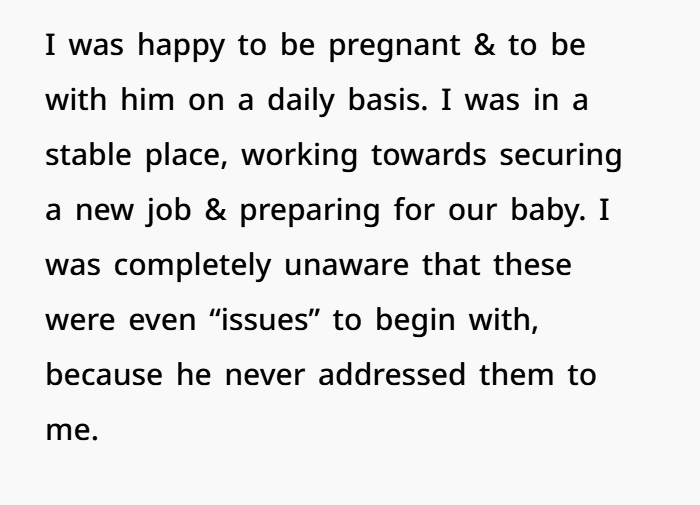
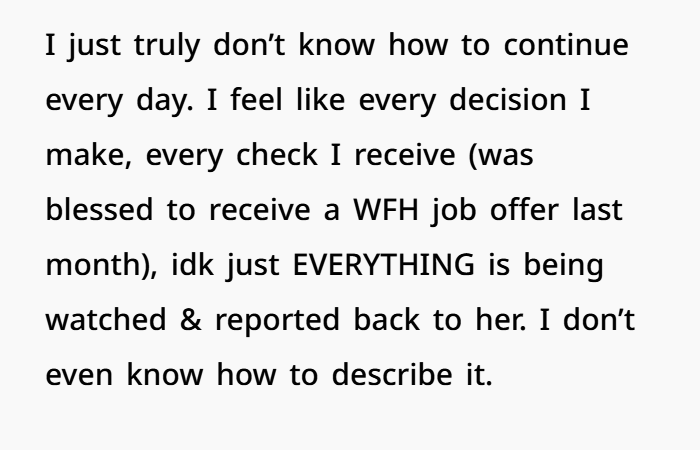
During her sixth month of pregnancy, a woman began noticing changes in her relationship. Her partner was communicating with his mother constantly through calls and texts, and he would often leave the apartment to take these conversations privately. This pattern made her suspicious about what they might be discussing.
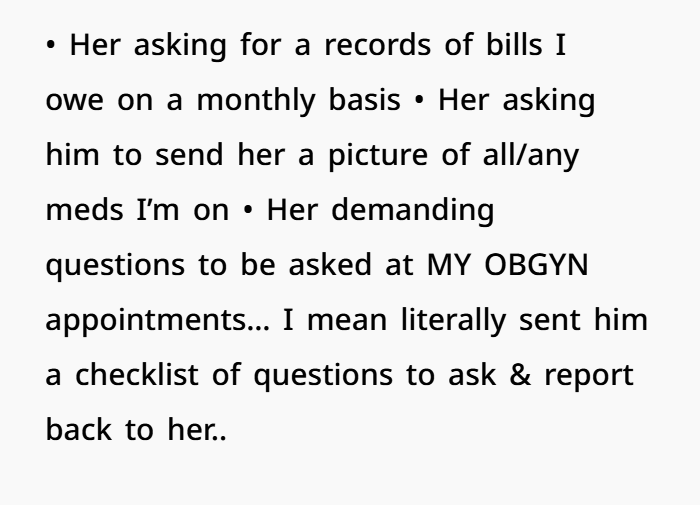
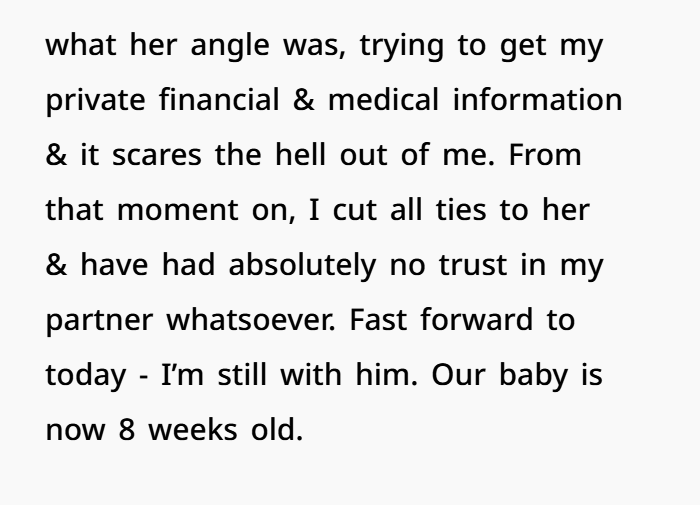
When she eventually looked at his phone, what she found shocked her. Rather than evidence of an affair, she discovered extensive conversations between her partner and his mother about her personal life. The discussions included details about her finances, bank accounts, pregnancy status, medical treatments, medications, work situation, and family matters. Most concerning, her mother-in-law had explicitly requested access to her banking information and requested updates about her prenatal care.
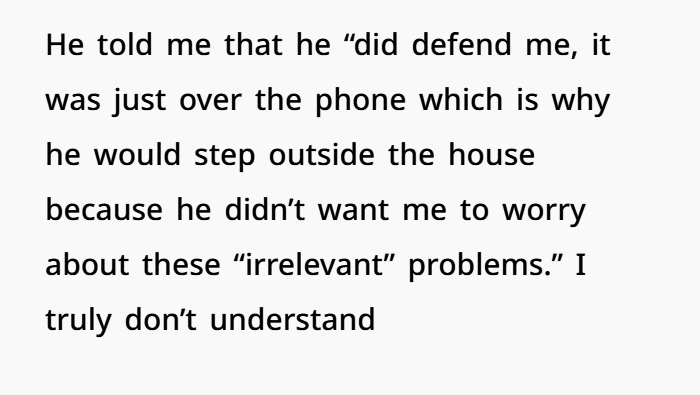
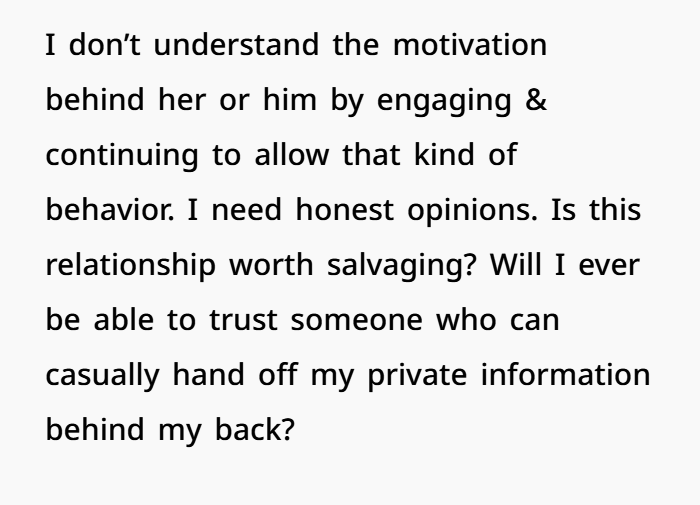
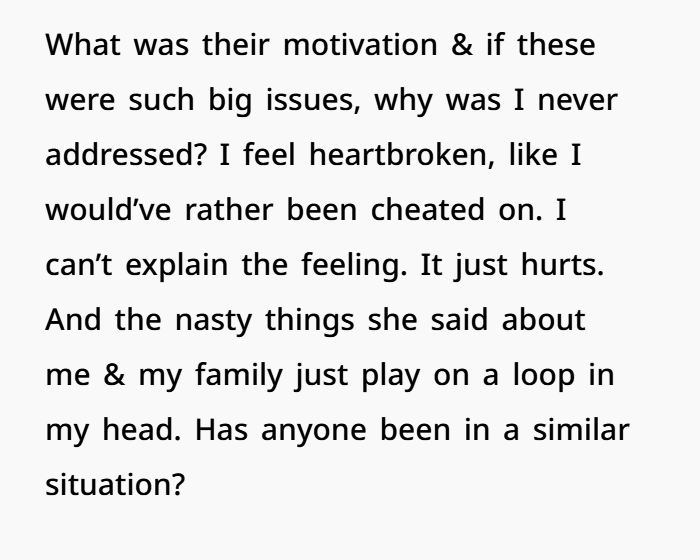
The messages revealed something even more hurtful. Her mother-in-law had made negative comments about her character and questioned her reasons for being with her son. Although her partner claimed he had defended her in some conversations, the larger issue became clear: intimate personal information had been shared without her consent or knowledge.
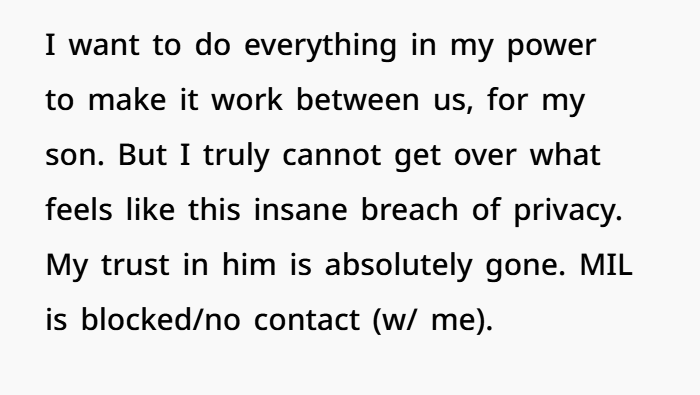
Today, four months after discovering this betrayal, the couple has a two-month-old baby. The woman has cut off direct contact with her mother-in-law, but rebuilding trust has proven difficult. Financial decisions, health appointments, and even routine conversations about paychecks now trigger anxiety that sensitive details might be shared again. She hopes couples therapy and stronger boundaries might repair the damage, but questions whether trust can truly be restored.








Understanding the Broader Issue Beyond Family Conflict
This situation extends far beyond typical family disagreements or relatives speaking negatively about one another, which are common occurrences in many families.
The core concern here is more serious in nature. According to the woman’s account, her partner was systematically collecting and disseminating her private information without her knowledge or authorization.
The information allegedly shared encompassed highly sensitive details, including banking information, monthly financial obligations, prescription medications, details of her pregnancy, and records from prenatal medical consultations.
These revelations raise significant questions about personal confidentiality, relationship trust, and financial security in relationships.
Distinguishing Between Personal Privacy Breaches and Legal Violations
An important distinction exists between violating someone’s personal privacy and breaking laws like HIPAA in the United States.
HIPAA’s protections primarily cover healthcare providers, insurance companies, and their designated business partners.
It typically does not prevent ordinary citizens from discussing medical information they happen to know about someone else.
For instance, if a family member learns about someone’s diagnosis and mentions it to another relative, this represents a personal privacy violation but may not constitute a HIPAA breach.
That said, it remains a serious breach of personal boundaries and trust.
The situation differs when medical facilities or providers improperly disclose protected health information or when someone accesses medical records without authorization.
Taking Control of Medical Privacy Rights
When concerned about medical privacy, individuals have concrete steps they can take. Direct communication with healthcare providers is essential. She can inquire about her current authorization list and determine who is permitted access to her treatment information.
It is equally important to explicitly document who should be excluded from receiving any health-related communications.
This becomes especially critical when dealing with sensitive matters like pregnancy care, psychiatric treatment, controlled substances, or reproductive health decisions.
Healthcare offices should be able to explain their privacy protocols and review any existing permissions currently documented in her medical file.
Patients have the right to comprehend exactly how their confidential health records are being handled.
Financial Information Demands Special Attention
Banking and account information deserves separate consideration from health privacy concerns.
While asking someone about their spending habits crosses into personal territory, requesting banking access details represents a much graver violation.
Banking information must be safeguarded with utmost care and vigilance.
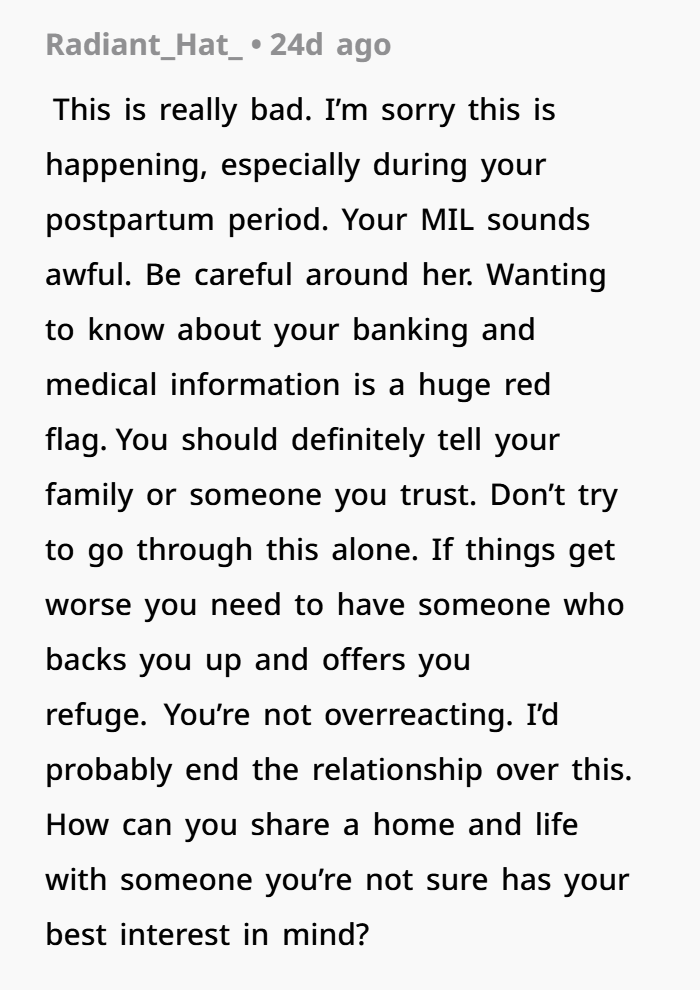
Regardless of the mother-in-law’s intentions, reviewing account security would be prudent.
The woman could establish strong, unique passwords for banking platforms and activate two-factor authentication wherever available.
Reviewing recent transactions and ensuring banking passwords and details cannot be accessed through shared computers or accounts represents good practice.
These precautions reflect basic financial safety practices and do not necessarily indicate fraud has already occurred.
Why Financial Security Protections Matter
Sensitive financial data connects to numerous accounts and services. These connections span checking accounts, savings vehicles, credit facilities, borrowing arrangements, investment portfolios, and retirement funds.
If potentially confidential information has been exposed, reviewing and strengthening account security becomes worthwhile. Appropriate steps might include modifying passwords, reviewing which devices are currently signed in, and enabling account activity notifications.
Depending on circumstances, monitoring credit reports or exploring identity protection services might provide additional security reassurance.
Taking these protective actions does not necessarily mean identity theft has transpired. Rather, it reflects responsible stewardship of financial information.
The Partner’s Justification Raises Concerns
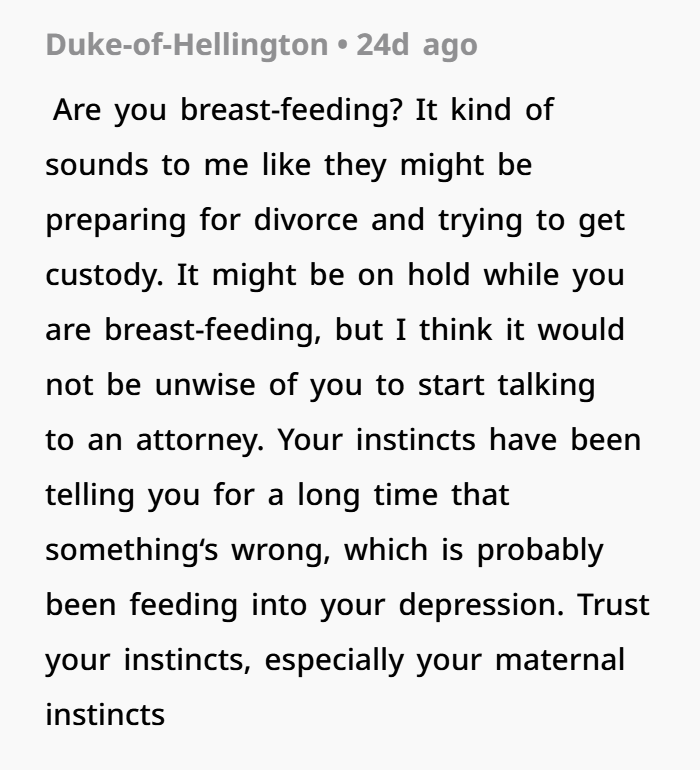
The partner’s explanation for his behavior falls short of addressing the core problem. He suggested his mother’s concerns were minor and claimed he stepped outside during calls to shield his partner from worry.
While his intentions may have been protective, this approach backfired by creating a different problem. His partner remained completely unaware that her personal circumstances were being scrutinized and discussed.
Even if the mother-in-law believed she was acting out of genuine concern, good intentions do not grant anyone license to collect and share another adult’s confidential medical or banking information.
This represents a fundamental boundary violation in relationships.
The Central Question: Can Trust Be Restored?
As the woman contemplates the future, the most significant question may not involve forgiveness alone.
The critical inquiry centers on whether her partner grasps the depth of her betrayal.
An apology means little without accompanying behavioral change.
He needs to recognize that his partner controls who receives her personal information.
He needs to commit to never sharing private details without explicit permission.
Establishing firm boundaries with his mother becomes necessary.
Full transparency about what information was previously disclosed could also help the couple work through rebuilding trust.
How Professional Counseling Might Help
Trust ruptures sometimes can be mended, though the process demands substantial time and effort.
Professional couples therapy provides both partners a confidential setting for discussing what occurred.
They can address family boundaries, financial privacy, health information protection, communication styles, and trust restoration in structured sessions.
A qualified therapist can facilitate conversations and help establish mutually acceptable standards regarding what information may or may not be shared with extended family members.
While therapy cannot guarantee relationship recovery, it offers both parties an opportunity to assess whether rebuilding the relationship represents a realistic goal.
The Postpartum Context Matters Significantly
An often-overlooked factor is that the woman remains in the early postpartum period at only eight weeks after delivery.
She has described experiencing fear and repeatedly dwelling on negative statements made about her character.
She also senses that her actions are continuously monitored and scrutinized.
Her justified concerns about privacy violations deserve serious acknowledgment and should not be dismissed.
Her discovery of the messages provided concrete evidence that her instincts were correct about information being shared.
Simultaneously, the emotional strain she experiences during this vulnerable postpartum phase also warrants compassionate attention.
Postpartum Emotional Health Requires Professional Support
The period following childbirth involves significant physical transformations and emotional upheaval for new parents.
Some people develop postpartum mood disorders, postpartum anxiety disorders, or other emotional health challenges during this time.
When sadness, worry, apprehension, or emotional strain significantly disrupts daily functioning, professional evaluation becomes important.
Consulting with an obstetrician, general physician, or licensed therapist should be considered a priority.
Insurance plans typically provide mental health coverage that new parents can access during this period.
Seeking professional assistance does not invalidate her legitimate betrayal concerns.
A person can experience real relationship trauma while simultaneously benefiting from professional support in managing the emotional consequences.
Partner Actions Will Demonstrate Commitment to Change
Nobody can determine whether this couple should remain together except those directly involved. However, the woman can monitor her partner’s subsequent behavior as an indicator.
Does he genuinely acknowledge how his actions caused harm?
Has he stopped sharing private matters with his mother?
Does he actively maintain and respect new privacy boundaries?
Does he maintain transparency as trust slowly rebuilds?
Is he genuinely invested in couples therapy as a path forward?
Affirmative answers to these questions would signal true understanding of the damage caused.
Conversely, if he continues covertly sharing information or dismisses her concerns as unfounded, the fundamental problem persists despite appearances of resolution.
Motives Cannot Be Perfectly Understood
The mother-in-law’s true motivations remain opaque based on the available information.
Perhaps she felt concerned about her son’s wellbeing and choices.
Perhaps she harbored financial worries or doubts.
Perhaps she struggled with appropriate boundaries regarding her son’s adult relationships.
Alternative explanations might also exist.
Drawing definitive conclusions about someone’s character from limited messages proves unwise.
The actual behavior itself carries more significance than speculating about intentions.
An adult’s reproductive status, pharmaceutical treatments, banking details, outstanding debts, and household finances represent inherently confidential matters.
Family relationships do not automatically grant access to this sensitive information.
Money and Trust in Romantic Partnerships
Financial matters form a crucial component within romantic relationships for many couples.
Partners typically discuss shared living expenses, credit card balances, accumulated debt, emergency reserves, insurance needs, mortgages or rentals, investment decisions, and future retirement security.
These conversations function as meaningful partnership interactions and require strong mutual confidence.
Couples jointly determine which financial information stays private between them and what, if anything, can be discussed with family members.
After having children, financial discussions grow increasingly significant and complex. New considerations include health insurance selection, life insurance protection, emergency savings adequacy, childcare expenses, housing affordability, and long-term retirement planning.
These represent valuable conversations within a partnership, yet extended family members do not inherently require access to this financial information.
The Depth of Betrayal Extends Beyond Initial Appearance
The woman has expressed that this violation feels comparable to or potentially more painful than discovering infidelity. This reaction becomes more understandable when examining the complete situation.
The breach is not merely that negative comments were made about her by her in-law.
She believed she and her partner formed a unified team, preparing together to become parents and navigating pregnancy as a joint experience.
Discovering that intimate details about their shared life were being discussed with someone outside their partnership without her awareness represents an enormous violation of intimacy and trust.
This discovery can fundamentally shake someone’s sense of safety within their primary relationship.
Rebuilding Trust Requires Rebuilding Boundaries
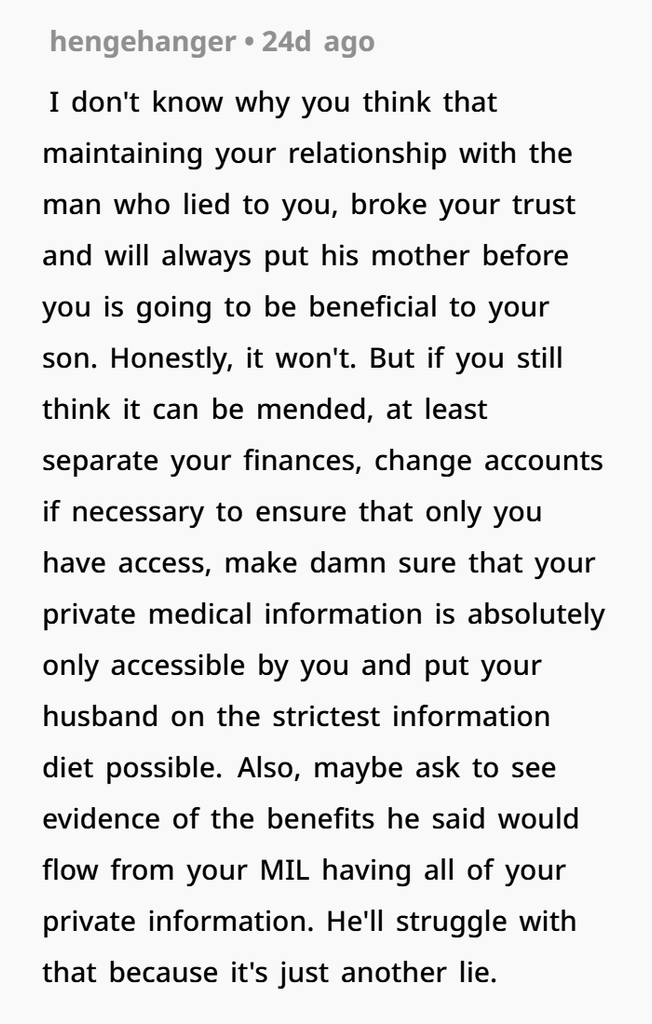
Should the couple choose to continue together, restoring trust will almost certainly require establishing clear, firm, and enforceable privacy boundaries.
Medical information cannot be shared without explicit permission from the patient.
Banking and financial information must remain rigorously protected.
Private matters relating to pregnancy, medications, financial obligations, health decisions, and household finances require careful handling and discretion.
The partner must consistently demonstrate through actions that he respects these boundaries.
This demonstration might involve increased openness about communications, firm limits placed on discussions with his mother, and genuine participation in couples therapy.
The relationship may have a viable path forward if circumstances change.
However, promises and words alone may ultimately prove insufficient.
Subsequent actions carry far greater significance than initial apologies.
If the partner respects her privacy and genuinely modifies his behavior, trust might gradually recover over time.
However, if private information continues flowing to his mother despite promises to the contrary, the problem remains unresolved and ongoing rather than purely historical.
Community Voices Weigh In